
Fraud Prevention Workflows: Match Evidence to the Value at Risk
Map gift cards, BNPL, refunds, bookings, tickets, paywalls, loyalty and specialist fraud risks to the evidence and server-side controls each workflow needs.
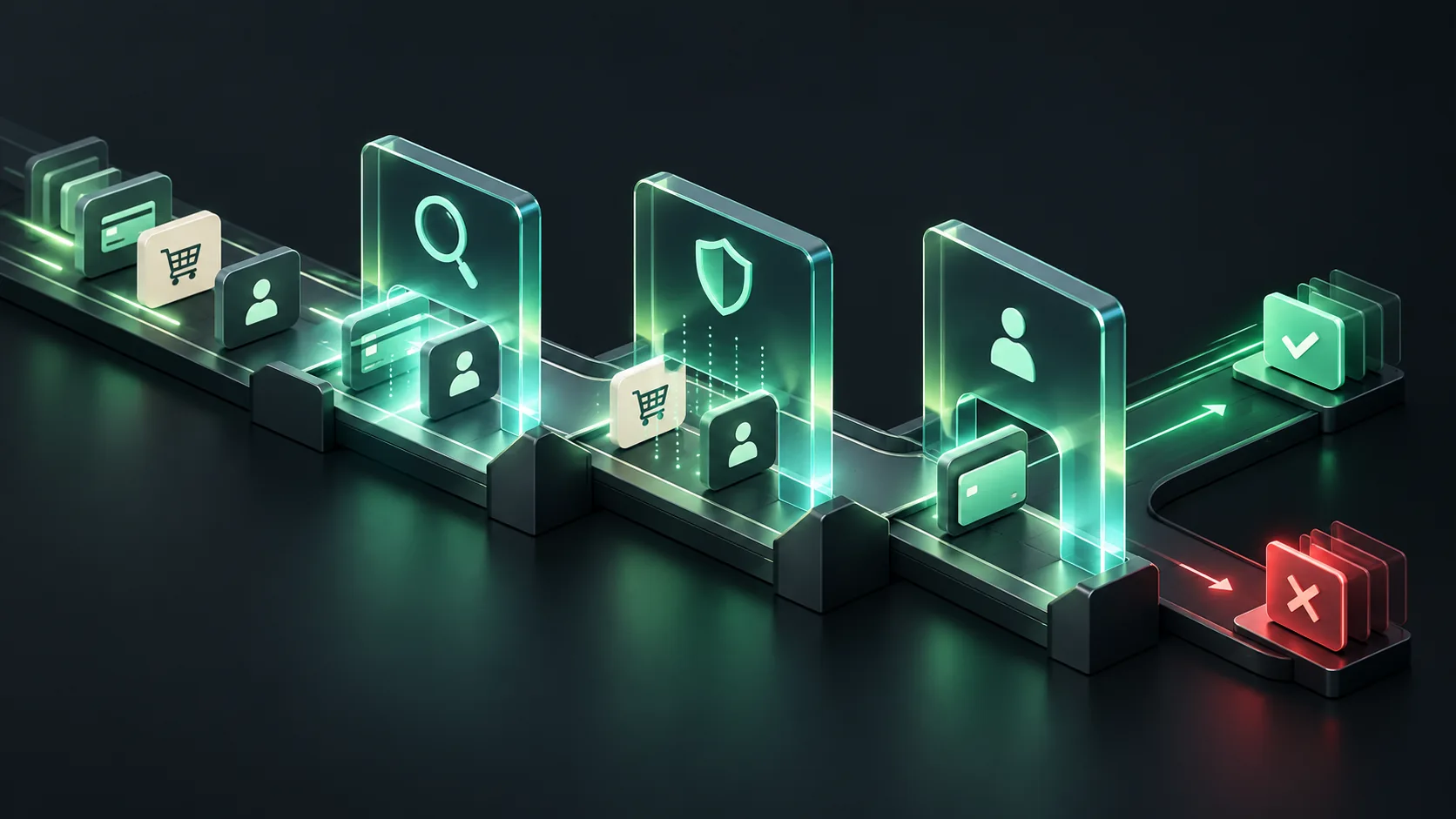
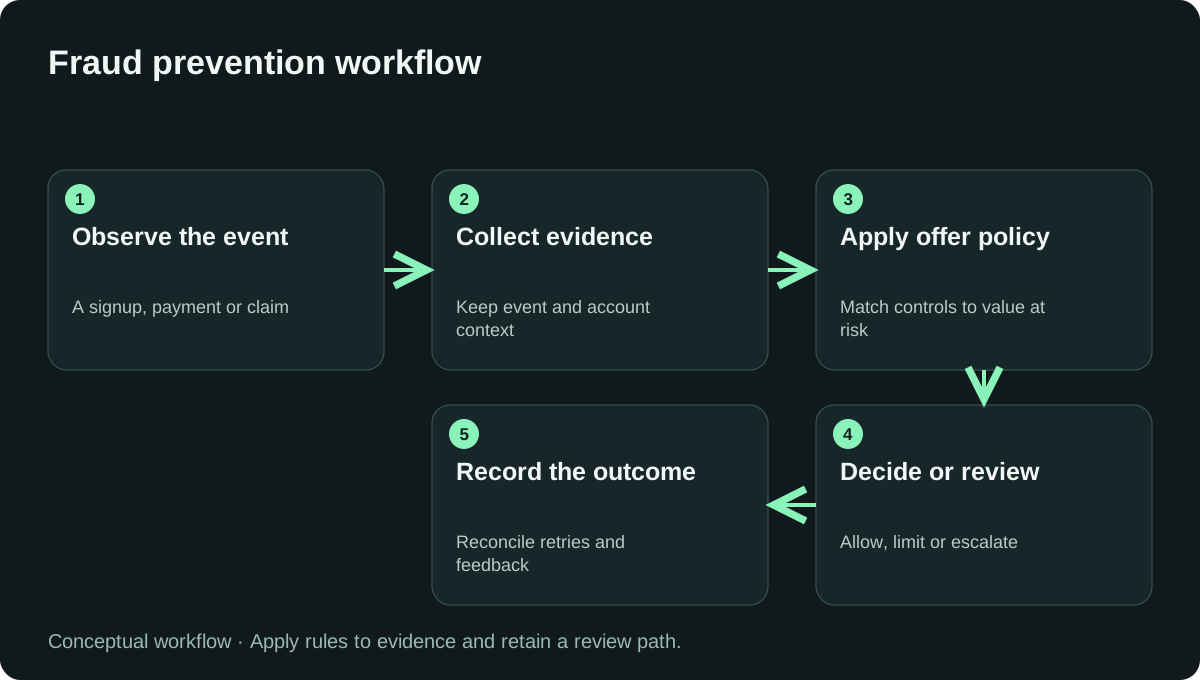
A fraud prevention workflow connects an observation to a business action and a recorded outcome. The evidence needed to release a gift card differs from the evidence needed to approve a booking change, a refund or account recovery. Choose a fraud decisioning platform by those workflows, including review, retries and reconciliation, rather than by a generic list of detection features.
The common question is when value becomes available and whether the decision can still be reversed. A risk result arriving after delivery may be useful for investigation while being too late to prevent that delivery.
What should a fraud decisioning workflow contain?
A useful workflow identifies the action, evidence, decision owner, intervention, ledger update and later outcome. It also records unavailable evidence and overturned decisions. The ShieldLabs comparison of fraud decisioning and detection explains why a score and an operational decision are different outputs.
| Workflow | Value at risk | Evidence to join | Control point |
|---|---|---|---|
| Gift cards | Stored value and redemption | Funding, account, delivery and redemption history | Issue, deliver and redeem |
| BNPL | Credit exposure and goods | Identity, account, credit and order evidence | Approval and fulfillment |
| Refunds | Returned funds or goods | Original order, delivery and prior claims | Refund authorization |
| Travel | Booking value and supplier commitment | Payment, passenger, account and change history | Booking, change and cancellation |
| Ticketing | Scarce inventory | Queue, identity, purchase and transfer rules | Reservation and checkout |
| Paywalls | Paid content or access | Authentication and entitlement | Content delivery |
| Loyalty | Points and reward value | Earn events, account and redemption ledger | Award, transfer and redeem |
| Marketplaces | Buyer, seller and transaction value | Profiles, account links and transaction outcomes | Listing, payment and payout |
How do gift-card fraud controls protect the value ledger?
Gift-card fraud prevention should follow value through funding, issuance, delivery, redemption and reversals. An account-risk observation can expose suspicious reuse, but the stored-value ledger must still prevent duplicate or unauthorized spending. Review the relationship between the purchaser and recipient rather than assume they are the same person.
ShieldLabs' gift-card fraud guide supplies related workflow context. Add controls for delivery changes, repeated attempts and account recovery. A clean device observation cannot establish that the funding source is authorized.
What is different about BNPL fraud prevention?
BNPL decisions can involve identity, account ownership, credit and fulfillment risk. Those questions need different evidence. Device intelligence may help connect applications or sessions, but it does not independently establish creditworthiness or satisfy an identity-proofing requirement.
The ShieldLabs BNPL guide discusses account and device context. Evaluate credit, identity and regulatory requirements with the appropriate providers and qualified specialists. Preserve the decision and evidence available at approval so later fulfillment or repayment outcomes can be reconciled.
How should refunds and chargebacks be evaluated?
A refund is an application or merchant process; a chargeback follows a payment dispute process. Join the original authorization, fulfillment, customer communications and earlier claims. Device evidence can support an investigation, but it does not prove that a delivery complaint is false.
Read our refund abuse guide, the refund prevention comparison and ShieldLabs refund and return article. For a merchant shortlist, the Medium ecommerce tools comparison distinguishes account and transaction layers.
Where does fraud enter a travel booking?
Travel fraud prevention spans the initial booking, payment, passenger or guest details, account changes and cancellation. A later itinerary or contact change can alter risk after an ordinary-looking purchase. Supplier commitments and refundability determine when a hold or review is still useful.
The ShieldLabs travel-fraud guide provides further reading. Record the original booking and each change as distinct events. A traveler's new network or location is expected in many legitimate journeys and should not be treated as takeover proof by itself.
How do ticket-scalping controls differ from ordinary bot checks?
Ticket-scalping prevention combines request handling with inventory, purchase limits and transfer rules. A queue can regulate arrival without proving independent eligibility. A human can also violate a purchase limit, while an automated client may be authorized for a different task.
The ShieldLabs ticket-scalping article offers workflow context. OWASP's sensitive business flow guidance is a primary source for the broader application risk. Enforce reservations and purchase limits on the server, including retries.
How should a paywall enforce paid access?
Paywall abuse prevention begins with authentication, authorization and server-controlled entitlement checks at delivery. Recognizing a returning visitor can support account-sharing analysis; it should not replace the access check or make private content available to an inferred identity.
The ShieldLabs paywall guide and account-sharing solution describe adjacent controls. Our account-sharing article explains why multiple sessions need policy context. Seat sharing, family use and compromised accounts require different responses.
What does loyalty fraud prevention need beyond account linking?
Loyalty programs need an auditable ledger of point issuance, adjustments, transfers and redemptions. Link rewards to eligible source events and support reversals when underlying activity is canceled. Account relationships can expose repeated beneficiaries, but a shared device does not resolve the program's terms.
Referral and affiliate fraud have a similar boundary: a registration event is not automatically a payable introduction or commission. Record self-referrals, settlement and reconciliation separately. The promotion abuse guide discusses benefit eligibility across these programs.
How should marketplace fake-profile risk be handled?
Marketplace fraud prevention separates profile authenticity, prohibited relationships and transaction outcomes. A new seller may be legitimate but have little history. A long-standing account may be taken over. Device and network evidence helps prioritize review, while fulfillment, disputes and payout changes require their own checks.
Use the ShieldLabs ecommerce industry page as vendor context and the Shield Users directory for account-protection categories. Confirm whether a shortlisted product observes listings, payments or only the account entry point.
Which specialist risks require different evidence?
Voice fraud and account recovery
Voice fraud detection evaluates call or speech-related evidence and the account action being requested. Browser audio fingerprinting is a different technique. If a caller requests a payout or recovery change, authenticate the action through an appropriate channel; caller ID or a familiar-sounding voice alone is insufficient evidence of ownership.
Brand impersonation and takedowns
Brand impersonation detection requires discovery and preservation of evidence about domains, profiles, messages or other assets. Takedown is a separate process involving the relevant service or authority. An on-site device-risk tool does not by itself discover all external impersonation or remove a fraudulent domain.
Credential exposure monitoring
An exposed credential is a risk signal for an account, not proof that an attacker has used it. Authentication, session review, recovery and sensitive-action checks remain necessary. Consult the OWASP credential-stuffing prevention cheat sheet for primary defensive guidance.
How can you test a workflow before enforcement?
Use a labeled pilot and replay operational failures. This is a test design, not a claim of measured vendor results. In an illustrative set of 300 legitimate refund requests, 9 unnecessary holds represent a 3% hold rate. Report the resolution time as well as the count; a hold resolved in minutes has different impact from one left unresolved.
- Name one protected action and the moment value is released.
- Define the evidence required and its acceptable age.
- Bind results to server-controlled user and action IDs.
- Test duplicate requests, delayed callbacks and missing results.
- Record review decisions, appeals and reversals.
- Reconcile later payment, fulfillment and account outcomes.
- Measure legitimate-user impact alongside prevented loss.
The business fraud directory and Fraud Tool Atlas can support shortlisting. For integration-level comparison, see our fraud detection APIs guide.
Disclosure: linked ShieldLabs material and related comparison sites are part of the project portfolio. Product descriptions are attributed, and no shared accuracy benchmark is claimed. This guide was reviewed in 2026; send source-specific corrections to RubyScore.
Compare tools for this workflow
For a documented shortlist and a provider-selection checklist, read 7 Best Fraud Detection APIs for Developers in 2026.
Frequently asked questions
What is the difference between fraud detection and decisioning?
Detection supplies observations or assessments. Decisioning applies policy and operational steps to an action, including review, holds and final outcomes. A useful workflow preserves the evidence and reason for each decision.
Can one device score protect every business workflow?
No. Device context may be useful across workflows, but identity proofing, payment authorization, credit, fulfillment and entitlement need their own evidence. Evaluate the action and the product's documented scope.
Where should a fraud check run?
Run the relevant check before the action releases value when prevention is required. Use a backend-verifiable result and an idempotent action update. Later results can support investigation but may arrive too late to stop delivery.
What should happen when a provider result is late?
Use an explicit fallback appropriate to the action, record the missing evidence and reconcile the later result. Do not silently interpret a timeout as a clean verdict, and prevent delayed callbacks from repeating a benefit or overwriting a newer decision.
Sources and editorial review
Reviewed on October 27, 2026 by RubyScore Research. Product capabilities are attributed to the linked vendor documentation. Send source-specific corrections to RubyScore.
[1] Fraud Decisioning vs Fraud Detection: Which Do You Need?.
[2] How to Prevent Gift Card Fraud | ShieldLabs.
[3] How to Prevent Buy Now, Pay Later (BNPL) Fraud.
Further sources for fraud decisioning platform
These references cover specific parts of the workflow discussed above. Provider explanations, product pages, documentation and controlled demos have different evidential roles; the notes state how each source should be used.
| Source | How to use it in this workflow |
|---|---|
| ShieldLabs demo: Loan Application Fraud Prevention Test | Inspect this controlled workflow example; do not treat a demo as a production accuracy benchmark. |
| ShieldLabs demo: SMS Pumping Fraud Prevention Test | Inspect this controlled workflow example; do not treat a demo as a production accuracy benchmark. |
| ShieldLabs demo: Survey Fraud Prevention Test | Inspect this controlled workflow example; do not treat a demo as a production accuracy benchmark. |
| ShieldLabs documentation: Use cases | Check this operational reference for the current contract, limits, supported behavior or correction path. |
| ShieldLabs documentation: Investigate a user | Relate this scenario to the application action, qualification rule and later outcome record. |
| ShieldLabs documentation: SMS pumping | Relate this scenario to the application action, qualification rule and later outcome record. |
| Will iCloud Private Relay and Chrome IP Protection break your fraud detection? | Background on What is browser IP masking?. Verify implementation details in the primary references. |
| Detect Incognito Mode: Limits and Better Fraud Signals | Background on Why incognito detection is probabilistic, not guaranteed. Verify implementation details in the primary references. |
| Device-based authentication: recognizing the trusted device behind a login | Background on What is device-based authentication?. Verify implementation details in the primary references. |
| Account and offer abuse in ecommerce: a merchant's playbook | Background on What is account and offer abuse?. Verify implementation details in the primary references. |
| Ecommerce Bot Detection: Signals, Layers and Rollout | Background on Which bot types target ecommerce and what damage they cause. Verify implementation details in the primary references. |
| Fraud Prevention Strategies for Web Apps | Background on What is a fraud prevention strategy for a web app?. Verify implementation details in the primary references. |
| How to detect fake reviews | Background on What is review fraud?. Verify implementation details in the primary references. |
| Impossible travel detection: reading the device behind the location | Background on What is impossible travel detection?. Verify implementation details in the primary references. |
| How to prevent fintech fraud: the device layer across the fraud types | Background on What is fintech fraud?. Verify implementation details in the primary references. |
| How to prevent marketplace fraud: types, signals, and the actor behind them | Background on What is marketplace fraud?. Verify implementation details in the primary references. |
| Measure First: Reduce False Positives, Keep Coverage for Fraud Ops | Background on Causes of False Positives and Why They Matter Operationally. Verify implementation details in the primary references. |
| Audit Ready Velocity Checks for Fraud Teams With ShieldLabs Signals | Background on How velocity checks work: rule components and patterns. Verify implementation details in the primary references. |
| ShieldLabs research archive — page 12 | Navigate the publication archive and inspect the dates and primary sources of relevant articles. |
| ShieldLabs research archive — page 6 | Navigate the publication archive and inspect the dates and primary sources of relevant articles. |
| Fintech fraud prevention. | Read the provider-stated product or use-case scope; verify the selected integration before applying a policy. |
| Marketplace fraud prevention. | Read the provider-stated product or use-case scope; verify the selected integration before applying a policy. |
| Ticketing fraud prevention. | Read the provider-stated product or use-case scope; verify the selected integration before applying a policy. |
| Travel fraud prevention. | Read the provider-stated product or use-case scope; verify the selected integration before applying a policy. |
| Stop SMS pumping. | Read the provider-stated product or use-case scope; verify the selected integration before applying a policy. |
| One signal layer, every kind of abuse and fraud | Check publisher context, commercial assumptions or service scope during provider evaluation. |
Filtering bots before your next campaign?
RubyScore filtered 500,000+ bots for Somnia and 243,000+ for Linea using on-chain reputation and Proof-of-Human ID.
Get Score


