
12 Best Multi-Accounting Detection Tools for Teams in 2026
Compare twelve multi-accounting tools by account links, device evidence, decision scope and review workflow before acting on duplicate-beneficiary claims.
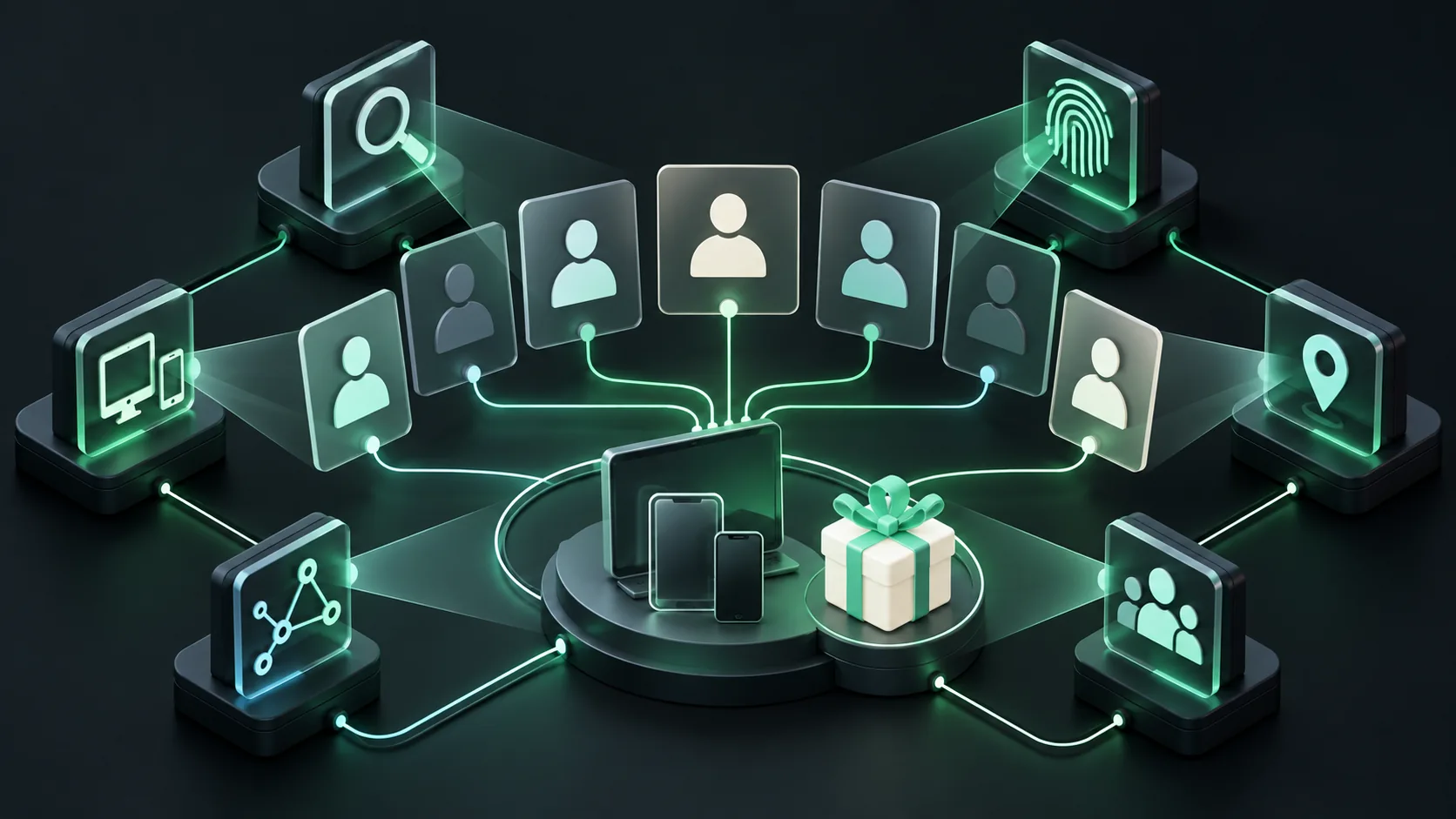
Multi-accounting detection tools should connect accounts with interpretable evidence and a clearly defined policy scope. Compare ShieldLabs, Verisoul, Castle, Fingerprint, SEON, Sift and TransUnion TruValidate by the relationships they expose and the operational work that follows. A device link can support investigation, but it does not automatically prove common ownership or prohibited participation.
One person may be allowed several workspaces while being allowed only one welcome bonus. Several family members may share a device. The program boundary matters as much as the strength of an account link.
The expanded shortlist includes different control layers. An identifier, an enrichment API, a challenge, an enforcement product and a business-policy engine are not interchangeable. Use the documented scope in the table to decide what to evaluate; inclusion is not a claim that every product detects every attack or fits every application.
What distinguishes this comparison from a fingerprinting shortlist?
This 2026 review focuses on the account graph and review outcome rather than identifier persistence alone. We examined documented account or device relationships and how a team can use them. There is no common accuracy or loss-reduction benchmark behind the list order.
Disclosure: ShieldLabs and related comparison publications are in the project portfolio. Vendor material supports capability descriptions; account examples are evaluation designs. Send source-specific corrections to RubyScore.
Which account-linking model should you compare?
| Tool | Documented scope | Where it fits | What remains in your app |
|---|---|---|---|
| ShieldLabs | Device, network and account context | Teams connecting observed risk to an account action | Confirm the client SDK, server result contract and account-binding policy |
| Verisoul | Account relationships | Products reviewing related accounts within a stated program | Confirm group membership, legitimate shared environments and the explanation exposed to reviewers |
| Castle | Application-event risk | Teams instrumenting explicit signup and login events | Check the event schema, score scale and policy response for the selected endpoint |
| Fingerprint | Identification events and device signals | Developers maintaining their own account and outcome model | Check current SDK/API versions, event binding, retention and supported device environments |
| SEON | Selected device and identity enrichment | Teams choosing several relevant evidence types for one decision | Confirm which modules, fields and account settings are included in the evaluation |
| Sift | Event history and fraud operations | An instrumented product with review and feedback processes | Identify required historical events, result timing and the route for confirmed outcomes |
| TransUnion TruValidate | Device reputation and associations | Teams adding device context to an established risk workflow | Confirm the selected module, collection requirements and how an association is explained |
| SHIELD | Device-first event intelligence | Device-led account review across the supported app or web environment | Verify collection support, result timing and the device/account relationship used by the policy |
| Rupt | Device and account-abuse context | Products evaluating repeated account participation or shared access | Confirm the API and verification scope and preserve the policy for legitimate shared use |
| Incognia | Device, location and tamper evidence | Location-sensitive or mobile-centered account journeys | Verify supported collection, evidence availability and behavior when location data is unavailable |
| Kasada Account Intelligence | Device-to-account continuity | Teams investigating coordinated activity beyond the initial bot request | Distinguish the account product from bot defense and inspect the associations available for review |
| LexisNexis ThreatMetrix | Digital identity and device reputation | Organizations joining network intelligence to an established review process | Check the selected integration, regional data scope and the explanation of returned risk evidence |
1. ShieldLabs: link the relationship to account abuse
ShieldLabs multi-accounting prevention describes account and device evidence relevant to repeated participation. Compare the detection with the program's definition of an eligible beneficiary.
Evaluate: whether a reviewer can connect the observed relationship to a particular benefit and prior decision. A useful case explains why a relationship matters now, including any earlier appeal, rather than displaying an unexplained cluster of accounts.
2. Verisoul: define which accounts belong in the comparison
Verisoul Groups documents a boundary for account comparison. This is relevant where repeat participation is allowed across programs but restricted within one.
Evaluate: the intended scope before enabling grouping. An incorrectly partitioned graph can hide relationships, while an unnecessarily global policy can penalize valid participation. Confirm the design and product requirements with the vendor.
3. Castle: relate device context to an application event
Castle's device-fingerprinting documentation describes device-related account assessment. The buying question is how that evidence reaches the event where participation or value is granted.
Evaluate: registration, redemption and later account activity separately. A relationship discovered at signup can have a different meaning when the user joins a permitted second workspace or tries to obtain another restricted benefit.
4. Fingerprint: build the account graph yourself
Fingerprint supplies identification events for backend use. An engineering team can connect those observations to users and outcomes under its own graph and policy model.
Evaluate: the cost of maintaining historical joins, identifier changes and corrected outcomes. Joining all accounts to the latest device record can erase the observation that actually informed an earlier grant. Recognition and policy quality should be reported separately.
5. SEON: investigate the supporting evidence
SEON device intelligence provides a device layer within a wider fraud stack. Evaluate which observed attributes and account inputs support the relationship under investigation.
Evaluate: missing collection, supported environments and reasons visible to a reviewer. Similar browser settings, shared IPs and account overlap do not have equal evidential strength. Avoid treating all relationship types as one confidence label.
6. Sift: use the event history around a benefit
Sift's developer documentation describes event collection and decision workflows. For multi-accounting, examine whether the integration captures account creation, qualifying actions and benefit outcomes consistently.
Evaluate: feedback quality and the team's review process. A graph that links registrations without knowing which benefits were valid cannot, by itself, determine who should lose eligibility. Preserve the rule version and confirmed outcome.
7. TransUnion TruValidate: device reputation and associations
TruValidate Device Risk describes device recognition and account associations. Assess whether its evidence and coverage contribute to your own account population and investigation process.
Evaluate: the distinction between unknown devices, prior reputation and the relationship being reviewed. External context can enrich a case but does not automatically establish that a particular offer's terms were violated.
8. SHIELD: device-first event intelligence
SHIELD describes device intelligence, event screening and account relationships across supported application journeys.
Best fit: Device-led account review across the supported app or web environment. Check before choosing: Verify collection support, result timing and the device/account relationship used by the policy.
9. Rupt: device and account-abuse context
Rupt describes device, browser and network signals with hosted verification paths for account sharing, takeover and fake signups.
Best fit: Products evaluating repeated account participation or shared access. Check before choosing: Confirm the API and verification scope and preserve the policy for legitimate shared use.
10. Incognia: device, location and tamper evidence
Incognia documents device recognition, location analysis and tamper signals for onboarding, login and transaction decisions.
Best fit: Location-sensitive or mobile-centered account journeys. Check before choosing: Verify supported collection, evidence availability and behavior when location data is unavailable.
11. Kasada Account Intelligence: device-to-account continuity
Kasada Account Intelligence describes device-to-account relationships for repeated offers, account takeover, sharing and related account abuse.
Best fit: Teams investigating coordinated activity beyond the initial bot request. Check before choosing: Distinguish the account product from bot defense and inspect the associations available for review.
12. LexisNexis ThreatMetrix: digital identity and device reputation
LexisNexis ThreatMetrix describes digital identity and device-related risk context for fraud assessment.
Best fit: Organizations joining network intelligence to an established review process. Check before choosing: Check the selected integration, regional data scope and the explanation of returned risk evidence.
What should a multi-accounting pilot label?
Label account relationships and policy violations separately. This helps distinguish a correct device match that was misused by policy from a mistaken relationship. The ShieldLabs multi-accounting guide discusses implementation context.
- Identify the program and benefit rule.
- Record the relationship type and original observations.
- Include legitimate shared devices and organizations.
- Preserve confirmed independent participants as a control cohort.
- Record restrictions, reviews, appeals and reversals.
- Keep unknown outcomes visible instead of counting them as fraud.
For illustration, 18 linked-account cases among 300 reviewed claims represent 6% of that reviewed cohort. The number is not a fraud rate until the cases are resolved against the program rules. Report the selection method and unresolved count alongside it.
The abuse-platform comparison and fake-account tool directory provide supplementary candidates. Evaluate each product's graph, evidence and review workflow before converting links into enforcement.
Guides behind this comparison
For the underlying evidence and implementation questions, read Airdrop Farming Rings: Wallet Clusters and Multi-Accounting Evidence and Ban Evasion Detection: Account History, Devices and Wallet Evidence.
Frequently asked questions
Is multi-accounting always prohibited?
No. Products can permit multiple accounts, workspaces or personas. Define the restricted action or benefit before using relationship evidence to enforce a policy.
Is a shared IP sufficient to link accounts?
It is a weak context signal on its own because unrelated users can share an address. Evaluate other observations and distinguish a review lead from a confirmed relationship.
How is multi-accounting different from account sharing?
Multi-accounting concerns several accounts potentially controlled by one actor. Account sharing concerns one account used by several participants. A platform may need different policies and evidence for each.
What happens after a mistaken account link?
Correct the case and propagate the decision to related restrictions and eligibility records. An appeal should not leave an unexplained hidden penalty attached to the account graph.
Sources and editorial review
Reviewed on October 27, 2026 by RubyScore Research. Product descriptions are attributed to the cited documentation. Corrections can be sent to RubyScore.
[1] ShieldLabs multi-accounting prevention — product documentation or the attributed publication above.
[2] Verisoul Groups — product documentation or the attributed publication above.
[3] Castle's device-fingerprinting documentation — product documentation or the attributed publication above.
Further sources for best multi-accounting detection tools
These references cover specific parts of the workflow discussed above. Provider explanations, product pages, documentation and controlled demos have different evidential roles; the notes state how each source should be used.
| Source | How to use it in this workflow |
|---|---|
| Kasada Alternative: ShieldLabs Comparison | Read this vendor-authored comparison as a source of evaluation questions, then verify the relevant product reference. |
| Verisoul Alternative: ShieldLabs Comparison | Read this vendor-authored comparison as a source of evaluation questions, then verify the relevant product reference. |
Filtering bots before your next campaign?
RubyScore filtered 500,000+ bots for Somnia and 243,000+ for Linea using on-chain reputation and Proof-of-Human ID.
Get Score


